Bernarda Alba
The House of Bernarda AlbaBernarda Alba is the formidable matriarch at the center of Federico García Lorca’s The House of Bernarda Alba. She turns a household into an instrument of order: mourning becomes confinement, commands become daily discipline, and the preservation of the family’s public name takes precedence over acknowledging private realities. Her authority is unmistakable, but so is its failure. By rejecting warnings and demanding silence, she helps bring about the scandal she fears; at the end, she responds to Adela’s death by imposing one last version of events on the surviving family.
Identity and Authority
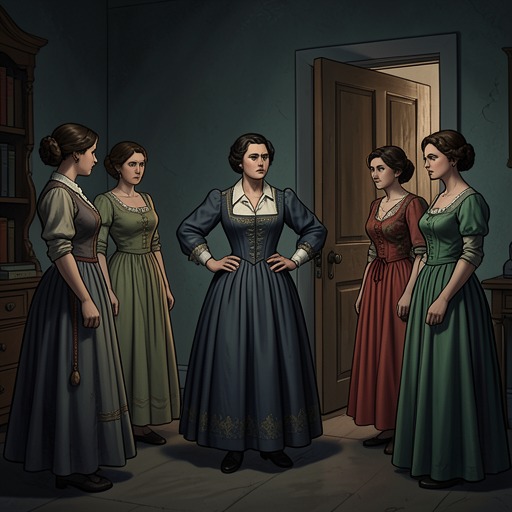
The audience first encounters Bernarda through the household’s reaction to her. The play opens in an empty inner room in her house, with thick white walls, oppressive summer heat, and the tolling of bells. The Servant and Poncia discuss the recently deceased Antonio María Benavides while Bernarda is away at his church service. Their conversation establishes the resentment her rule has produced, particularly in Poncia, who has served in the house for thirty years. When Bernarda enters after the service with her five daughters and the village women, she makes authority public: she orders the Servant to be silent, criticizes the condition of the house, and dismisses her. The public mourning ritual thus sits beside the household’s established pattern of command and resentment.
Bernarda’s authority is both verbal and physical. She strikes her daughters with her stick, silences dissent, and treats obedience as the household’s governing principle. When Magdalena protests the lot assigned to women, Bernarda declares that in her house things are done as she commands and reduces the gender division to the work allotted to each: “Hilo y aguja para las hembras. Látigo y mula para el varón.” The contrast between the daughters’ needlework and the freedom associated with men makes domestic labor part of the discipline she enforces.
Her position also rests on economic power and social standing. The commentary identifies her ability to exploit workers and her prestige in the community as material supports for her domination. Yet the same community makes her vulnerable: villagers are ready to seize on scandal and damage her name. Bernarda’s insistence on control therefore combines command over those inside her household with anxiety about judgment from outside it.
Mourning, Confinement, and Reputation
After Antonio María Benavides’s death, Bernarda announces that the family will mourn for eight years. She tells her daughters to occupy themselves by embroidering their trousseaus, prescribing domestic work in place of movement beyond the house. Magdalena says she will never marry, but Bernarda silences her. The decree makes mourning not only a response to a death but also a means of regulating the daughters’ lives and expectations.
Bernarda’s concern with family honour governs what may be said as well as what may be done. She objects when Angustias has listened to men’s gossip and strikes her before sending the girls away. Later, when the daughters argue, Bernarda warns that the neighbours may be listening through the walls. Gossip is not incidental background: it is a continuing threat against which she organizes household behavior. Her concern for appearances also surfaces in small acts of housekeeping and in her insistence that the house be properly prepared for mourners.
The play’s account of rural custom gives this control a wider social setting. Long mourning periods, the division between men and women, and the daughters’ sewing and embroidery belong to the traditional life the commentary describes. It also identifies arranged or loveless marriage and the comparative freedom of men as realities of that social order. Bernarda enforces these conventions within her home, but she is not their only representative: Poncia shares a concern with respectability, while the daughters recognize the unequal freedom men enjoy even as they resent their own position.
Warning, Blindness, and Conflict
Bernarda’s strictness does not give her reliable knowledge of what is happening around her. The commentary emphasizes the irony that she is anxious about her daughters’ possible sexual transgressions yet remains blind to what is unfolding within the household. Her pride and belief in her own infallibility lead her to reject Poncia’s attempts to alert her. As a result, the effort to prevent scandal helps prepare the conditions in which the concealed conflict intensifies.
The dispute surrounding Angustias shows how money and family relationships complicate Bernarda’s authority. Angustias is the daughter of Bernarda’s first marriage and the richest of the five sisters. The commentary notes that Antonio María Benavides left her considerably more money than he left his four natural daughters. Bernarda attacks Angustias after the revelation of this unequal inheritance, ostensibly because Angustias has put on powder on the day of her father’s funeral. The commentary raises, but does not resolve, the possibility that the stepfather’s financial preference points to a closer relationship with Angustias, and asks whether Bernarda suspects it. The uncertainty belongs to a household where secrets are sheltered by silence; it should not be mistaken for a fact established by the play.
Angustias’s wealth also shapes the marriage that becomes a source of conflict among the sisters. She is to marry Pepe el Romano, who is fourteen years younger than she is. The sisters connect his interest in Angustias to her inheritance and contrast her position with the younger daughters’ age and comparative poverty. Bernarda’s control over the family does not dissolve this rivalry or its underlying economic pressures; instead, it coexists with them, as the daughters’ suspicions and resentments gather beneath the rules she imposes.
The Village and Bernarda’s Moral Order
A report about Librada’s unmarried daughter exposes the violence sustained by the village’s code of sexual honour. Poncia tells the household that the young woman killed the child she had borne and concealed the body, which dogs later uncovered. A crowd is pursuing her, and men are coming from the paths and olive groves. Bernarda responds by urging the crowd to come armed and kill her. Adela objects, pleading that the woman not be killed. Bernarda’s response reveals how readily she accepts collective punishment when a woman’s conduct is made public.
This moment places Bernarda’s household rule within a broader system of reputation and gendered judgment. The commentary links her outlook to a historical culture in which family honour could be tied to women’s sexual conduct. It notes that the Spanish Penal Code of 1870 permitted a husband to restore his honour through bloodshed in specified circumstances, and that the provision was not repealed until 1963; the play does not depict that precise legal situation. Rather, Bernarda shares the mentality of an order in which reputation can authorize coercion and concealment. Her approval of the crowd’s pursuit of Librada’s daughter is a distinct act within that social logic, not a depiction of formal legal punishment.
The gap between Bernarda’s public authority and her failure to see the private crisis in her own house is central to her role. She is alert to the danger of neighbors hearing an argument, yet dismisses warnings from within the household. Her demand for silence may suppress the report of conflict, but it cannot resolve the conflict itself. In this way the play connects the family’s enclosed life to the village beyond it: both are structured by surveillance, judgment, and the pressure to protect appearances.
Adela’s Death and the Final Command
The play’s concluding crisis turns Bernarda’s effort to preserve authority into a cover-up. After Adela’s death, Bernarda refuses to go into the room, orders that Adela be taken down and dressed as a virgin, and insists that no one speak of anything else. She declares that her daughter died a virgin and orders that two bell tolls sound at daybreak. Martirio’s reply—that Adela was fortunate to have enjoyed Pepe—makes the concealed reality audible even as Bernarda tries to suppress it.
Bernarda’s response is not simply grief expressed in silence: she directs how the death is to be represented to the village and how the surviving daughters are to behave. She forbids weeping in front of others and tells them to cry only when alone. Her repeated command for silence echoes her first orders in the household and closes the play by restoring, at least outwardly, the discipline that the unfolding crisis has exposed as inadequate. The commentary identifies this insistence that Adela died a virgin as an expression of Bernarda’s concern for the family name, not proof that the public claim is true.
Bernarda’s ending preserves the contradiction that defines her character. She has the power to command the household and to shape its public account, but she cannot undo the consequences of the secrecy and repression she has enforced. Her authority survives as an order to keep quiet; the play leaves that order standing beside the evidence of what it cannot repair.